
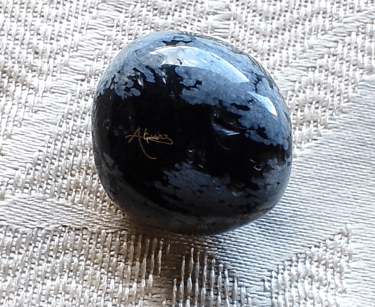
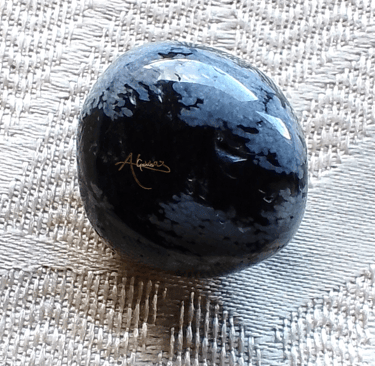
Cristobalite, Fayalite
Locality: Canyon Butte occurrence (Couger Butte), Canyon Butte, Siskiyou County, California, USA (Locality at mindat.org)
Obsidian (volcanic glass) cools too quickly to crystallize. Thus, it is unusual to see minerals attached. The spheres of high temperature cristobalite (SiO2) are actually the result of devitrification, or loss of silica from the obsidian. Most unusual. 5.9 x 3.8 x 3.8 cm.
Rob Lavinsky, iRocks.com licensed under the Creative Commons Attribution-Share Alike 3.0 Unported license
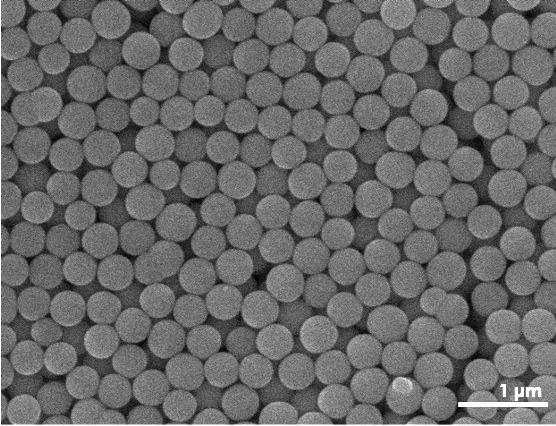
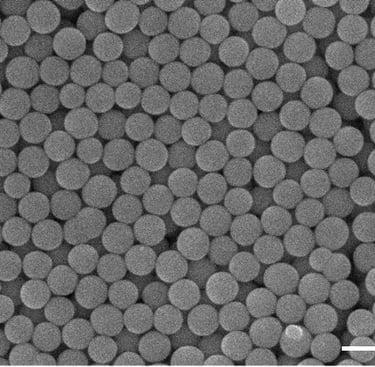
Scanning Electron Microscope image of colloidal particles. Synthesis performed by Dr. Iotzin Rios de Anda and image taken by Dr. Jean-Charles Eloi at The Electron and Scanning Probe Microscopy Unit at the University of Bristol -Licensed under the Creative Commons Attribution-Share Alike 4.0 International license
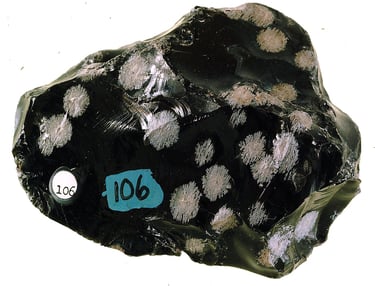
Snowflake obsidian - destruction and creation all at once
“Some things are hurrying to come into being, others are hurrying to be gone, and part of that which is being born is already extinguished. Flows and changes are constantly renewing the world, just as the ceaseless passage of time makes eternity ever young.” - Marcus Aurelius, Meditation
As touched upon in my opening blog, the process of formation is fascinating to explore in the case of snowflake obsidian. In the first instance, obsidian is a natural glass formed after the violent eruption of lava from an Argentinian, Guatemalan or Russian (or several other locations) volcano, at a temperature between 800-1200 °C degrees which then cools down rapidly, relative to the cool rate of crystalline gemstones, causing the silicon and oxygen elements to join together in a seemingly disordered, amorphous formation. As a result of this amorphous bonding, we see the mineral known as obsidian. Obsidian can be uniformly black but it can also contain patches of greyish white material on the surface which are commonly referred to as 'snowflakes'. The more defined these snowflakes are, the more desirable the piece of snowflake obsidian would be.
The snowflakes are actually a result of a process called devitrification or de-glassing essentially. These are areas within the amorphous glass structure that become crystallised, that is areas within an apparently random arrangement of silicon and oxygen atoms become orderly and show a repeated 3D structure. This crystallised form of silicon dioxide is called cristobalite. Eventually, the cristobalite snowflakes grow out of the obsidian, forming into protruding spherulites which are chalky white and round and completely subsuming the amorphous glass. Ultimately, all obsidian becomes devitrified over time and whilst we don't know all of the factors which impact the length of time this takes, it is rare to find obsidian or any natural glass dated older than 135 million years.[1]
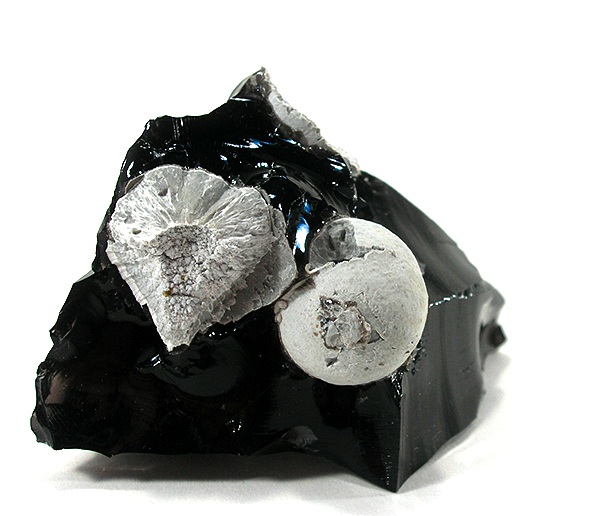
Within glass material, it has been discovered that devitrification either occurs like an avalanche or gradually overtime. Glass is considered to be a metastable substance – metastability is a state of being in a specific system where the system is stable but is not at it's lowest potential energy. It is not exactly clear what causes crystallisation to occur within glass but it has been possible to predict where in the structure it might happen. Currently the thinking is that these avalanches occur by chance; there is likely an answer to this 'unknown' that we are yet to discover, since nothing in nature appears to truly occur by chance. If all obsidian will eventually reorganise into the crystalline material known as cristobalite, then that speaks to a tendency toward order in the universe. Structure and order do not go hand in hand with 'chance'. Is the cause of crystallisation some form of 'life force' energy ?
Obsidian inspiration in the X-Files (spoiler)
In season 2, episode 9 of the critically acclaimed TV show X-Files called Firewalker, researchers discover a silicon rock in a volcano which they describe as a 'porous obsidian'. In order to study it they crush it which releases spores that infect the researchers. The spores eventually grow into a silicon based lifeform which protrudes out of the mouth of the host, ending the the host's life. This storyline bares uncanny resemblance to what goes on with cristobalite spherulites crystallising and growing out of obsidian. What if 'life' is not just confined to being 'carbon-based'? What if 'life' could also be silicon based?
The X-Files is not the only sci-fi TV show which fictionalises silicon dioxide as the villain. There are also a few episodes of Star Trek: The Next Generation which involve a 'crystalline entity'; one of the episodes is called 'Silicon Avatar'. In the episodes the crystalline entity is a snowflake like, intelligent and destructive crystalline lifeform floating through space which consumes all organic matter using electromagnetic attraction.
Predicting snowflakes
In order to get some understanding of the mechanism of devitrification, various scientists have used colloidal or hard-sphere glass as an approximation of natural glass. This is because the particles resemble the way silicon and oxygen atoms are arranged but are much larger, allowing for better observation of events within the material. In 2020, researchers from Jawaharlal Nehru Centre for Advanced Scientific Research (JNCASR) and the Indian Institute of Science (IISc) created visualisations of devitrification for the first time, using colloidal glass viewed through an optical microscope. They were able to observe two different paths of de-vitrification: 1 - gradual crystallisation over time, 2 - a rapid, sudden avalanche. The avalanche path was theorised previously by Sanz et al in a 2013 paper titled "Avalanches mediate crystallization in a hard-sphere glass". They found that the velocities of certain particles increased suddenly, causing crystallization of neighbouring particles. If they randomly altered the velocity of different particles, then the distribution of avalanches and subsequent crystallization also changed. Aside from particle velocity, there was also a correlation between the occurrence of crystallization and the spatial density of the particle arrangement. That is to say that there are areas of structural 'softness' within an amorphous natural glass which correlate to areas that are most likely to become crystalline at some point. This was demonstrated by Ganapathi, D., Chakrabarti, D., Sood, A.K. et al. using machine learning methods to analyse the structure of colloidal glass in a paper titled "Structure determines where crystallization occurs in a soft colloidal glass. Nat. Phys. (2020)".