
Lustre is the quality and quantity of reflected light from the surface of a stone – it is the shine. Metallic lustre however is slightly different because we are seeing something more than just reflected light. What do I mean by that? There is a concept in physics called Band Gap theory which describes the mechanism by which some materials display colour. In all cases, there is some physical interaction between incident light energy and the material that is displaying colour. The type of interaction determines the resulting colour and the colour can also be a result of a multiple types of interactions within the material. The interaction could be energy transfer in the band gap, it could be charge transfer between two elements present in a material for example the continuous transfer of one electron between titanium and iron in blue sapphires which we think causes the blue colour. The charge transfer causes absorption of some wavelengths of light and transmission of the rest. Is the charge transfer also happening in the dark? That takes us back to the first philosophical question – 'is a ruby still a ruby in the dark?'.
Gemmologists theorise about what the main cause of colour is for various materials but there is not absolute certainty yet. The atoms within a gemstone vibrate at various levels of energy and these energy levels can be grouped into two bands: the valence band which is filled with electrons and a conduction band that in most materials is apparently empty unless electrons in the valence band receive enough energy from an external source to move up to the conduction band. So the band gap is the amount of energy it takes for an electron to move out of the valence band and go into the conduction band where it it is “free”. In the case of metallic materials, the band gap is small to non existent, this means that the electrons exist in the 'conduction band' already and when they receive energy from the visible light spectrum, they absorb it but re-emit all of it i.e. energy/light in = energy/light out because they do not need to use the energy to travel anywhere within the material. With this being the case, metallic materials like gold and silver are exhibiting luminescence; they are glowing.
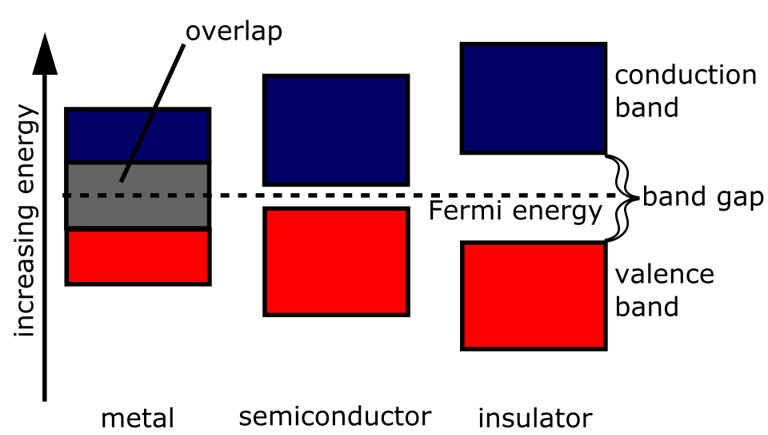
A comparison of the band gaps of metals, insulators and semiconductors.
Image by inductiveload licensed under the Creative Commons Attribution-Share Alike 2.5 Generic license
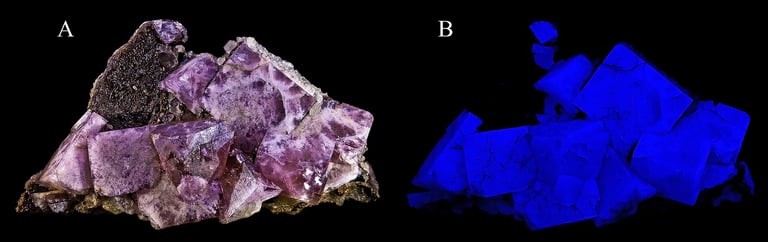
A - Fluorite in daylight; B - Fluorite in ultraviolet light
Image by Didier Descouens licensed under the Creative Commons Attribution-Share Alike 3.0 Unported license.
Metaphysics
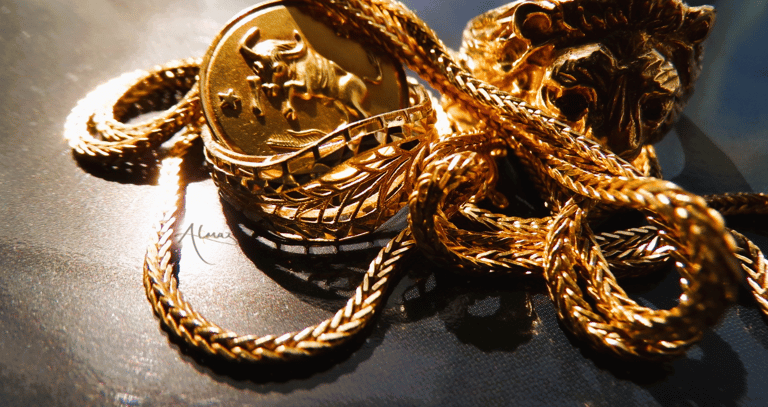
As gold is the featured picture at the top of this post, this section will focus on gold. Other metals will have differing properties. Gold is the precious metal associated with the Leo zodiac sign and is also aligned with the brow and crown chakras. In terms of healing, gold is thought to augment the strength of all gemstones and is therefore known as the master healer. It helps to clear negativity that has caused psychic and emotional blockages. If you are looking to receive the benefits of a particular gemstone then it is wise to set this stone in gold, whether in a pendant or a ring so that the benefits of the stone can be amplified.
Is metallic lustre a form of luminescence?
Metals are shiny but many different types of material have a shine to them. What makes the shine we see in metals so unique? Luminescence, specifically photoluminescence is defined as the emission of light energy from a material after it has been excited by a source of light energy such as visible or ultraviolet light. Typically when we think of luminescent gemstones, we might talk about how diamonds or fluorite react to ultraviolet light.