
Is a ruby still a ruby in the dark?
Physics and philosophy - Part 1
Talitha-Grace, MSc FGA
3/11/20264 min read
A place to begin
We use the language of physics in order to understand the optical and energetic properties of gems and minerals. And physics uses philosophy to apply mathematical interpretations of the world around and within us. In the understanding of physics, we are philosophising about how things work and it is philosophising since there are so very many unanswered questions and alternative perspectives on single matters.
The first philosophical question that struck me in my studies is this: Is a ruby still a ruby in the dark? In order for a stone to be defined as a ruby, it must first have the chemical composition of corundum which is Aluminium Oxide but it also must be described as red or pinkish red – it's predominant colour must be red. This kind of determination is not necessary in the case of most other gemstones, for example peridot is Magnesium Aluminium Iron Silicate and is green or yellow. It does not need to be yellowish green to be determined as a peridot. In fact it could be greenish yellow and still be a peridot. If a corundum is determined to be reddish pink, then it must be labelled as a sapphire, since pink is the dominant colour and not red. In the dark, factually a ruby is a corundum because light does not change it's chemical composition. However, without the opportunity to absorb and transmit visible light, a stone that is determined to be a ruby in the light, can no longer be called that when it is dark. So then is the stone simultaneously a ruby and a sapphire? Or is it part time ruby, part time sapphire? If we lived in perpetual darkness, would that stone always be a sapphire? What value do gemstones have in the dark?
The cause of colour in rubies
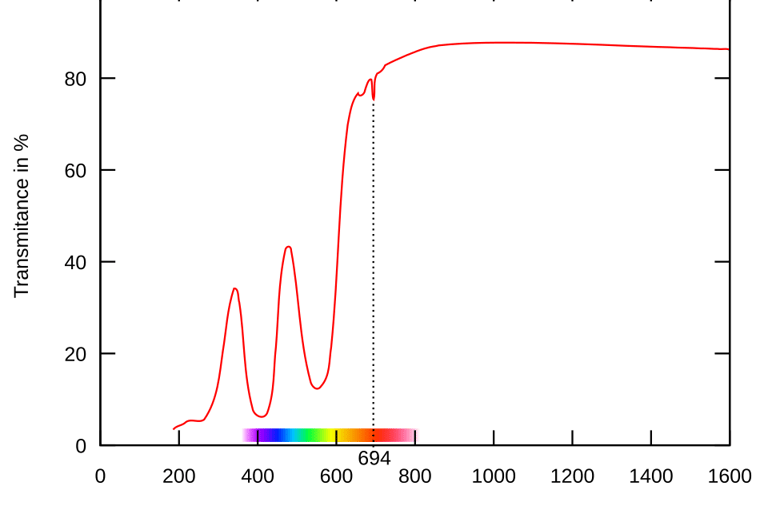
As stated above, the chemical composition of rubies is Aluminium Oxide, the element that is responsible for the red colour is Chromium which exists as an impurity within the structure of the crystal. This element is also responsible for the green colour of emeralds. The presence of Chromium in rubies causes violet and green wavelengths to be absorbed from the electromagnetic spectrum, whilst blue and red are transmitted. In many rubies, there are two narrow areas within the red end of the spectrum which are absorbed by the ruby; one of these narrow lines can be an emission line. The emission line demonstrates that the ruby has absorbed some light and re-emitted it. Crystals have the potential to decrease or increase absorbed electromagnetic energy - a topic to be covered at a later date.

Featured stone
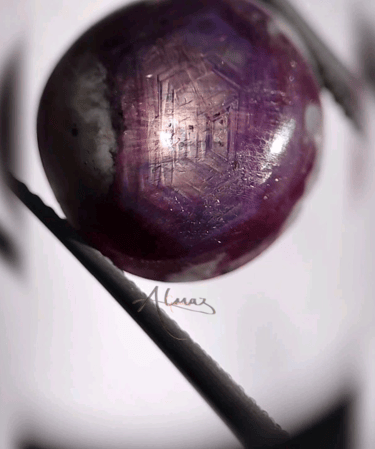
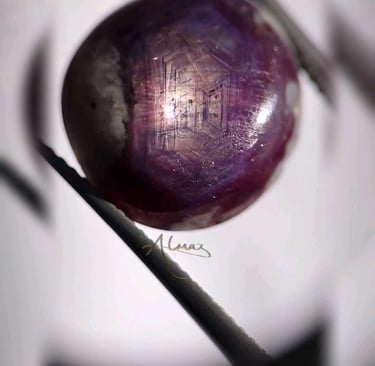
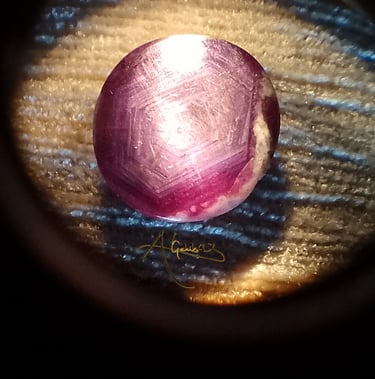
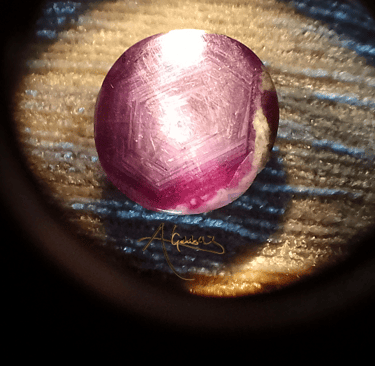
The stone featured at the top of this post is a rare purplish red star ruby, cut to include its host rock. Rutile needles which grow in three directions can clearly be seen, forming a hexagonal pattern reminiscent of the geometric gas cloud pattern located at the north pole of the planet Saturn. Although the needles are not abundant enough to display a sharp star, light directed at the top of the stone reflects from the surface of the rutile needles, revealing a majestic fuzzy star.
This star ruby is a great stone choice for a solitaire (single stone) statement ring and since it is corundum, it has a high hardness, second only to diamond on Mohs' scale, giving it high durability points. Equally, it would make an excellent focus stone for a pendant paired with a high carat gold chain to complement the dazzling star when it catches the light.
This is a true collector's stone; it boldly shows key features expected of a star ruby in an unusual setting of host rock, presumably marble. The imperfect nature of the rutile needle hexagon charms the viewer as the light reflects across each bundle.
Ruby is the July birthstone and metaphysically speaking it has long been thought to have a positive impact on the heart chakra, increasing courage and reducing anxiety.
Aristotle believed that if a ruby was worn either in a ring or as a pendant then the wearer would be less affected by the plague than people not wearing one. According to Ahmad ibn Yusuf Al Tifaschi, a gemmologist who travelled extensively in the 13th century to understand the properties of gemstones, corundum can prevent blood clots, stop haemorrhaging and protect the wearer from lightning strikes.
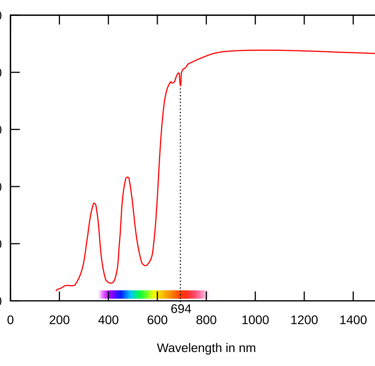
Optical and near-IR transmittance of a ca. 1 cm thick ruby crystal. Measured on an automatic Shimadzu spectrometer. Note the two broad blue and green absorption bands and one narrow absorption band on the wavelength of 694 nm, which is the wavelength of the ruby laser/emission line.
Image by FDominec licensed under the Creative Commons Attribution-Share Alike 4.0 International, 3.0 Unported, 2.5 Generic, 2.0 Generic and 1.0 Generic license
Hexagonal cloud at the north pole of Saturn - NASA/JPL-Caltech/Space Science Institute