
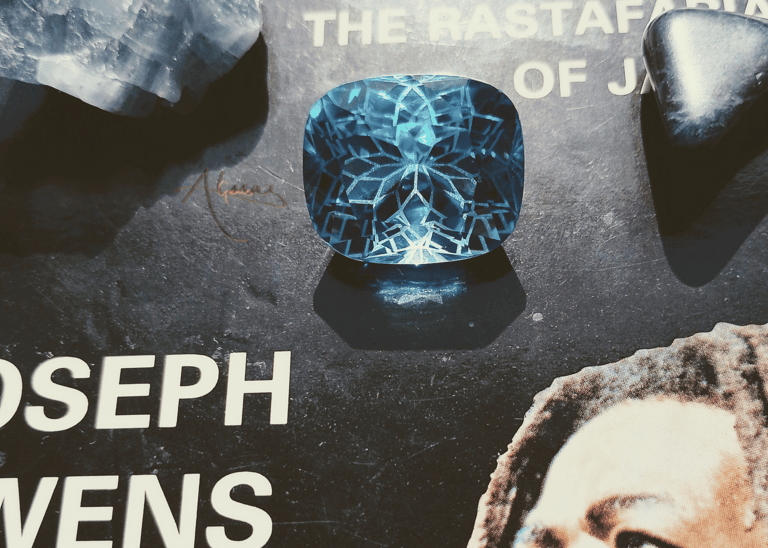
“The Principle embodies the truth that 'everything is in motion'; 'everything vibrates'; 'nothing is at rest'; facts which Modern Science endorses, and which each new scientific discovery tends to verify. And yet this Hermetic Principle was enunciated thousands of years ago, by the Masters of Ancient Egypt. This Principle explains that the differences between different manifestations of Matter, Energy, Mind, and even Spirit, result largely from varying rates of Vibration...The vibration of Spirit is at such an infinite rate of intensity and rapidity that it is practically at rest – just as a rapidly moving wheel seems to be motionless” - The Kybalion, A Study of the Hermetic Philosophy of Ancient Egypt & Greece by Three Initiates
Phonons and Photons
Everything is vibrating, moving and therefore in a state of motion; all at different frequencies all at once. All things interact with all things; if an object emits energy, it also absorbs, transmits, reflects or refracts. Gemstones which have a crystalline structure are fascinating because they have the ability to either increase or decrease a photon of energy that they receive. This change in energy is due to the photon interacting with phonons within the crystal. A phonon is defined as a discrete packet of energy. Just as a photon is thought of as a packet or particle of light, a phonon is a packet of heat or sound where heat is high energy and sound is low energy. It is a basic amount of energy that is proportional to frequency. Atoms within a crystal vibrate and impact each other by passing that vibration on; several phonons and therefore frequencies can be operating within a crystal at once. Altogether, this is known as the external lattice vibrational mode.
Both the chemical composition of a crystal and the physical structure (the way the atoms are arranged) impact how energy is absorbed and increased or decreased following that absorption. To put it very simply and possibly too simply, photons of electromagnetic energy, including light are absorbed by crystals and scattered; phonons of sound or heat within the crystal either become larger or smaller depending on the atomic structure and the scattered photon is emitted at either a higher or lower frequency across one or more wavelengths. This is known as Raman scattering.
Raman Spectroscopy
Raman spectroscopy was discovered by Sir Venkata Raman, an Indian physicist who won the Noble prize for this discovery in 1930. Regular spectroscopy, using a spectrometer, indicates which wavelengths of the visible light spectrum (400nm – 700nm) are absorbed by a gemstone. The Raman Spectrometer uses a single laser propagated wavelength of electromagnetic energy from any of the following sections of the spectrum: visible, near infrared, near ultraviolet, x-ray. The photon energy from the laser is absorbed and scattered within the crystal and then emitted. The emitted rays are either higher in energy or lower than the initial laser; the spectrometer measures these 'shifts' which are then plotted on a graph. A shift downward is known as a Stokes shift whilst a shift upward is known as an anti-Stokes shift. Each shift corresponds to the change in vibrational modes of the elements, molecules, groups of molecules or the crystal as a whole. If the energy within a crystal can be increased by incident electromagnetic energy then the concept of charging crystals either with sunlight, rain storms or earth burial is not such a strange idea.
The recorded shifts or spectrograph can be used to identify crystals and gemstones because specific elements and molecular arrangements have a signature interaction with each wavelength of the electromagnetic spectrum.
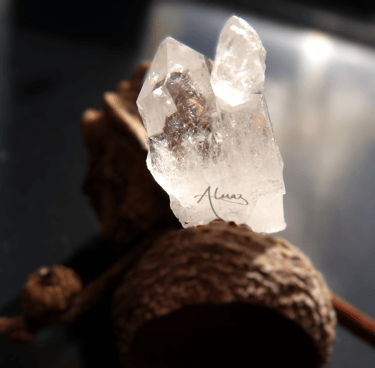
Raman spectrograph explained
Each peak represents a band of energy that correlates to an element included in the composition of the crystal. You can see that upon absorption of a single wavelength (532nm) of light from a laser, the emitted light from the crystal has shifted by a wave number of 1332cm-1, representing a decrease in the photon energy and a corresponding increase in phonon energy (atomic vibration). The emitted light has a wavelength of 572.574nm; larger wavelength = lower energy. I will expand on this calculation in a separate post.
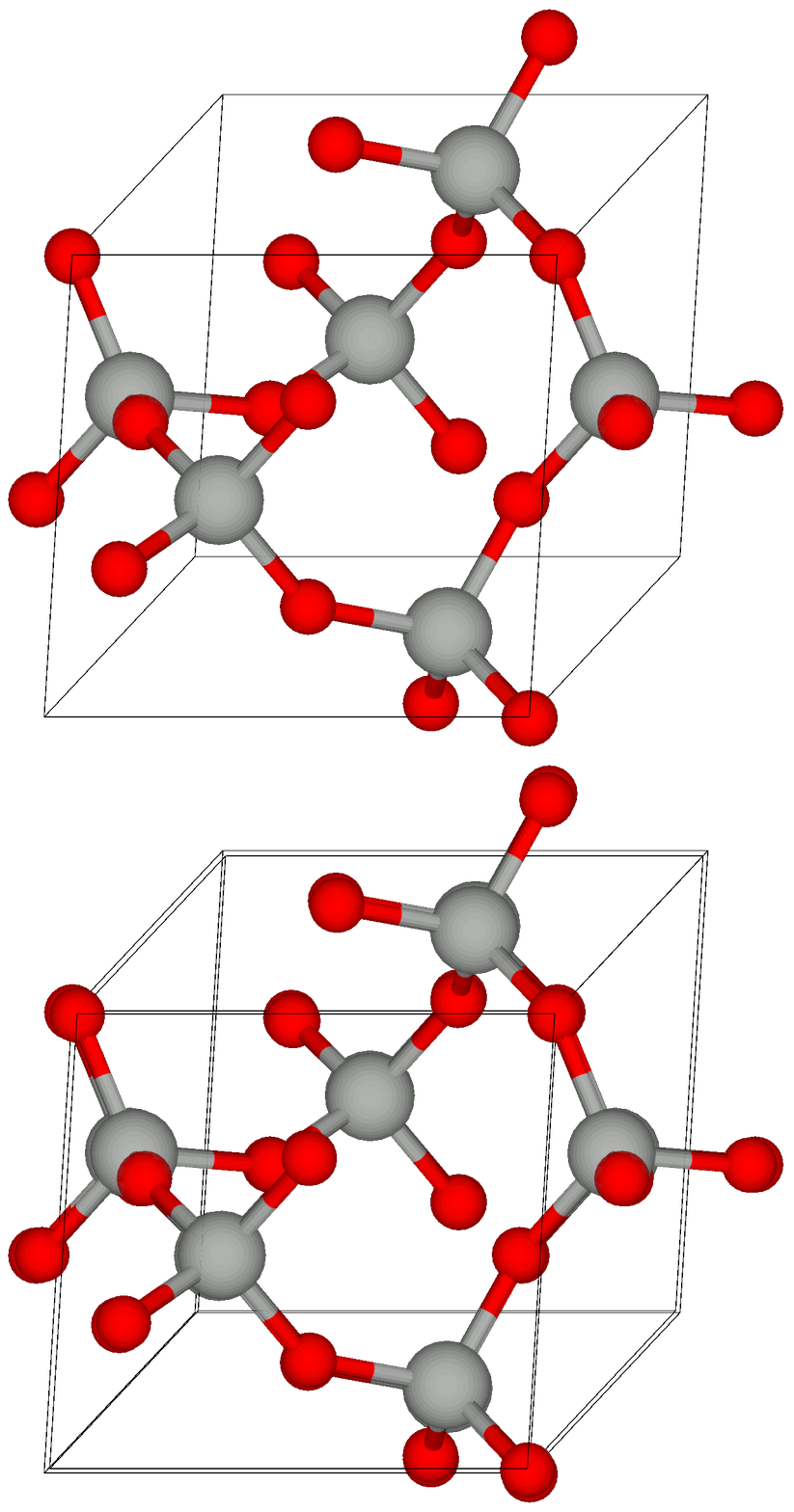
The example above shows a Raman spectrograph for a diamond. There is only one peak which corresponds to the fact that diamond is made of only one element which is carbon; there is only one energy band or phonon vibration which impacts the incident laser energy. The shift is the difference between the incident wavelength and the emitted wavelength. The example below is a Raman spectrograph for graphite which is a polymorph of diamond meaning that it has the same chemical composition, carbon alone, but a different atomic structure. The wave number of the shift is 1580cm-1, the difference is due to the structural difference between diamond and graphite.
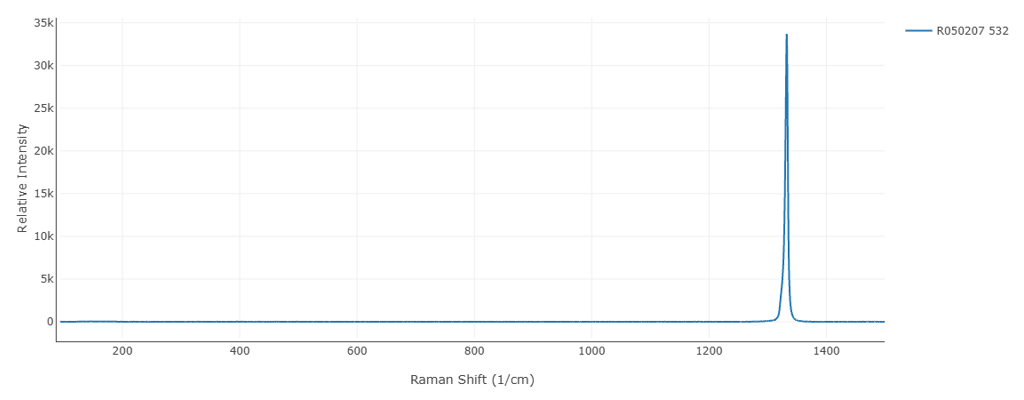
Raman spectrograph of a diamond, from the RRUFF database - RRUFF ID: R050207
Lafuente, B., Downs, R. T., Yang, H., & Stone, N. (2015). The power of databases: the RRUFF project. Highlights in Mineralogical Crystallography, T Armbruster and R M Danisi, Eds., Berlin, Germany, W. De Gruyter, 1–30.
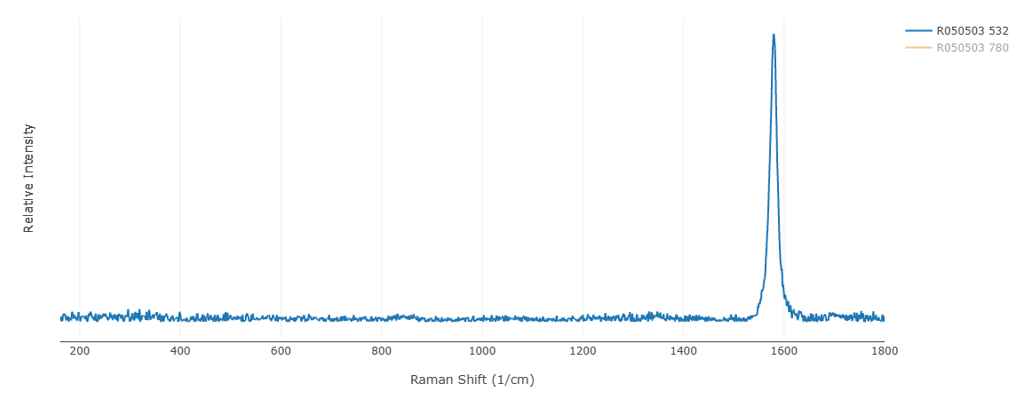
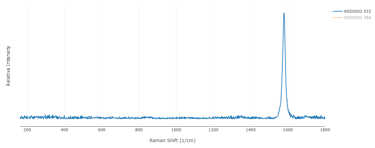
Raman spectrograph of graphite, from the RRUFF database - RRUFF ID: R050503
Lafuente, B., Downs, R. T., Yang, H., & Stone, N. (2015). The power of databases: the RRUFF project. Highlights in Mineralogical Crystallography, T Armbruster and R M Danisi, Eds., Berlin, Germany, W. De Gruyter, 1–30.
Food for thought
As it turns out, there is not one single definition of animacy. It is a linguistic concept that requires philosophical analysis and is generally assessed from the human perspective but what if we can perceive animacy through a new paradigm?
If a crystal has the ability to act on and respond to energetic stimulus then can it be considered as animate in some sense of the word? Can this be considered a form of language at an atomic level? Afterall the low energy vibrations are sound. The Raman spectrometer gives us the result of the absorption of a single wavelength of electromagnetic energy but in reality, several different wavelengths are hitting a gemstone at any given time dependent on the environment.
How do the phonons generated in the human body interact with electromagnetic energy? How does electromagnetic energy emanated from the human body interact with phonons in crystals?